

Forgotten Crafts and Trades of Ballymena 1800–1925


During the 400 years that Ballymena began its growth from a simple ford to an industrial town, businesses and their craftspeople have come and gone. We have been looking at the forgotten crafts and trades that have disappeared because of time, change and industrialisation. So, as a last part of our Linen Trade pieces, we have researched the documents that are available and have not only discovered the jobs that are no longer used but that are also forgotten. While in the process we have tracked down the names of some of those who were masters of their trades and the area of the town, that they lived in.
With advancements and the advent of industrial machinery, certain trades vanished. Additionally, as the home-based linen industry transitioned to factory production powered by water and steam, many trades became obsolete. Some people found employment in these factories; however, linen was either imported or became less popular. This shift occurred because cotton, which required less labour due to the faster and cheaper process of separating its fibres from seeds, replaced linen. Cotton was also easier to cultivate, harvest, and spin.
Linen trade
In certain areas, the linen trade and production involved the participation of all family members, such as the following:
The Anderson family Flax Growers Tully, Ballykeel, Drumfane, Ballymena 1850
The Bell family Flax Growers Drumfin, Kirkinriola Ballymena 1850
The Christie family Flax Growers Dunclug, Kirkinriola Ballymena 1850
The Beattie family Flax Growers Drumfane, Kirkinriola Ballymena 1850

It is interesting to see that there was an area in Ballymena, where flax was grown as a crop and close to the town for processing. The areas are now housing estates, where those who live there may be unaware that they live on a historical area, which was fundamental in the building of Ballymena, the new industrial town of the 1800’s.
D. Mulhollan Scutcher / Hackler Paradise Avenue 1900
Prepared flax for spinning, an important stage in linen manufacture.
T. Longmore Scutcher / Hackler Bridge Street 1900
Prepared flax for spinning, an important stage in linen manufacture.
H. Knox Scutcher / Hackler Ballymena 1900
Prepared flax for spinning, an important stage in linen manufacture.
S. Boyd Scutcher / Hackler James Street 1910
Prepared flax for spinning, an important stage in linen manufacture.
J. Conway Scutcher / Hackler Alexander Street 1910
Prepared flax for spinning, an important stage in linen manufacture.
Mary McKinley Flax Spinner Ballymena district 1850
Spun flax yarn. Part of the domestic linen production chain before mechanisation.
Henry S. Flax, Spinning Master shows how specialised spinning had become. As the need for different types of spun yarn was needed. Linen yarn produced thread for local weavers.
J. McDonald, Roughing Master, preparing linen yarn for weaving, dealing with rough or uneven fibres, ensuring yarn was sufficiently smooth and strong. Supervising workers involved in the preparation and checking the quality of yarn before it went to the weaver. A scutcher prepared flax fibre by removing the woody material from flax before spinning. A hackler combed the fibres, reading them for spinning.
John Smith Hand Loom Weaver. Church Street, Ballymena 1861
Worked from home or small weaving shops.
Robert Boyd Weaver Ahoghill area, 1800s One of many handloom weavers recorded in the district.
Another weaver, who became quite a celebrity of the times was “The Bard of Dunclug”, David Herbison. Herbison lost his sight as a child due to smallpox, later recovering the use of one eye. At about fourteen he learned linen weaving and spent much of his life in the weaving trade. In 1827 he attempted to emigrate to Canada. The ship Rob Roy was wrecked on the St Lawrence River near Quebec. Herbison survived, but after only a few weeks in Canada he returned home to Ballymena, where he married Margaret Archbold of Dunclug and settled there permanently.
Herbison wrote about local people, rural life, emigration, and the landscape around Ballymena. He was one of County Antrim's most important nineteenth-century poets and his is work linked the linen-weaving tradition with literature.
John Adair Flax Merchant / buyer Ballymena 1800s
He would buy the brown linen so that he could get it bleached and beetled before getting it finished to be ready for sale
Kennedy Linen manufacturer & bleacher Ballymena 1880
McKendry Linen manufacturer & bleacher Ballymena 1880
W. Gihon Bleacher Lisnafillen/Ballymena 1880
Bleached linen
A. Ferguson Beetler 1910
Finished linen cloth by beetling, part of the linen finishing process.
J. Livingstone, Preparing or Finishing Master, another forgotten stage of textile manufacture, where the linen was inspected for faults, fixed by beetling and rolling, ironing and packing it for sale.
P. M. Owens, Finishing Works, where Linen Finishers finished linen fabric. Preparing the cloth for sale and export.
Gilmour Yarn merchant Broughshane Street 1880
Linen yarn and part of the textile supply chain.
I have added these Factories & manufacturers, as they have now also disappeared:
J. Pryde Weaving factory proprietor/manager Leighinmohr, Ballymena 1910
Woven textiles Ballymena Weaving Co.
J. H. Bellis Weaver/manufacturer Braid River / Harryville, Ballymena 1910
Woven textiles. Associated with Braid River Weaving Factory.
George Bellis Weaver/manufacturer Braid River 1910 Woven textiles.
Partner in Braid River Weaving Factory.
J. N. Lamont Weaving manufacturer Railway Street, Ballymena 1910
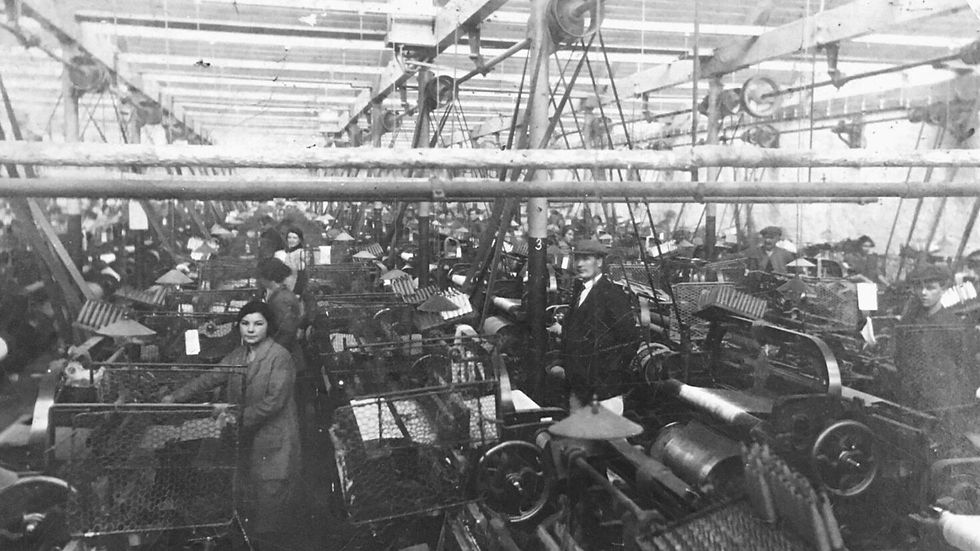
Phoenix Weaving Co. The Factory, itself was built around 1889 and run first, by the Gault Brothers, but was bought by Joseph Lamont and his sons and went on to buy the following other factories.

Riverside Factory, Antrim, Leighinmohr Factory, Ballymena, Braidriver Factory, Ballymena and G. H. Bellis yarn bleach works and closed in November 1990.
R. Ferguson Weaving manufacturer Slatt 1901 Woven textiles
Slatt Weaving Factory. Please note that a weaving factory owned by James & John Boal, originally built the factory, in around 1876, Ferguson, then ran it till 1924, when it went into liquidation.
As the decline and demise of the linen industry faded into the town’s history, so did other occupations. Ones that in one way or another had relied on linen trade were now finding either little business or being replaced by the town’s new industrial era.

Wood & Metal
James Mc Neice Cooper (Barrel Maker) Toome Road, Ballymena. 1800.
Wooden barrels, casks, tubs, Supplied barrels for breweries, merchants, distillers, and agricultural use.
John Cameron Cooper Henry Street, Ballymena 1910
Barrels and casks. Cooper associated with Ballymena and its distilleries.

Robert Young . Blacksmith Broughshane Street, Ballymena 1870 Horseshoes, farm tools, ironwork. Essential trade supporting agriculture and transport.
John Young Wheelwright Ballymena 19th century
Built and repaired carts and wagon wheels. Essential trade in an agricultural district.
Blayney Adair Carpenter Ballymena, Church Street area 1856
Building and carpentry work. A deed of 1856 specifically describes Blayney Adair of Ballymena as a carpenter. The property was on Church Street, fronting Wellington Street.

William McNeill Carpenter Ahoghill / Broughshane area c.1800
Luke McQuitty Carpenter Ballymena 1854
William McKeown Blacksmith Ballymena 19th century Produced horseshoes, tools and agricultural ironwork, gates, Central to rural life.

J. Thompson Whitesmith Henry Street, Ballymena 1910
Light metal goods. Whitesmithing was a specialist metalworking trade, who shapes thin sheets of iron or steel coated in tin, or works with pewter, lead, and silver to make items like cups, plates, and lanterns.

John Kane Iron foundry Harryville 1880
Cast iron goods/machinery. Foundry work became increasingly important with industrialisation
William Gildea Riddlemaker & Basket Weaver, Springwell Street Ballymena 1900
An excellent genuinely forgotten craft.
Robert Moore Tinsmith Broughshane Street, Ballymena 1910
Tinware, household utensils, repairs to metal goods
A. Watson Tinsmith Broughshane Street, Ballymena 1910
Buckets, cans, kettles, roofing and sheet-metal work. Listed as a tinsmith and resident/trader in Ballymena.

Transport
John M'Ilhenney Farrier Ballymena 1910
Horseshoes/horse care. Skilled trade supporting horses and transport.
John Weir Saddler Windsor Terrace, Ballymena 1910
Saddles/harness. Specialist leatherworking trade.

William Adair Saddler & Harness Maker Ballymena 1880
Saddles, harnesses, bridles Served farmers, traders and transport operators.
William Craig Saddler Ballymena 19th century
Produced saddles and harnesses for transport and farming. Supported horse-powered transport.
David Wilson Tanner and Currier Charlotte Street, Ballymena 1868 Slater's/Ulster Directory. Worked in tanning and currying, Finished leather. Prepared leather for saddlers and shoemakers.
Matthew Montgomery Coach maker Church Street, Ballymena 1880
Coaches and carriages
Malaghan Bros. Coach builders Broughshane Street, Ballymena 1880
Coaches

Food & Household
James Ross Miller Ballymena Flour & Grain 1800s Operated water- and steam-powered grain mills. serving local farmers
James McAllister Distiller Ballymena Early 1800s Required coopers, maltsters and labourers as part of the distilling trade.
John Wilson Maltster & Brewer Ballymena c.1854–55
A maltster is the professional who performs this craft, turning raw, hard grains into "malt," which provides the fermentable sugars, colour, and flavour needed to make beer. Served as a Town Commissioner; one of the few recorded maltsters linked to Ballymena's civic leadership. Town Commissioners were the forerunners to councillors that we have now, they began giving the commissioners powers to decide on how the town was ran in1828. These powers lasted till 1899, when Ballymena became an Urban District Council.

M. Kilpatrick Spirit dealer Mill Street, Ballymena 1880
Connected with the town's licensed trade.
George S. Wilson Aerated-water manufacturer Ballymena1888 Mineral/aerated waters. Early local manufacturing business.
David McCartney Butcher/grocer Linenhall Street Ballymena 1888
Meat/provisions Market-town food trade.
Charles Armstrong Woollen draper Church Street, Ballymena 1888
Woollen goods Textile retail/manufacturing connection.
T. G. Watson Grocer |Church Street, Ballymena 1888
Provisions. Local commercial trade.
Andrew Martin Soap & candle manufacturer 81 Church Street, Ballymena 1843
Soap & tallow candles
John Strahan Soap & candle manufacturer Church Street , Ballymena 1843
Soap & candles Also linen-yarn merchant
James Beatty Soap & candle manufacturer Wellington Street / Bridge Street 1862
Soap & candles
Andrew Martin Soap manufacturer Church Street , Ballymena 1862
Soap Manufacturing premises, stores, offices and yard
Samuel Strahan Grocer & chandler Church Street , Ballymena 1861
Chandlery/candles.
Other Trades
Hugh Davison Rope Maker. Rope and cordage. Bridge Street, Ballymena 1843
John Davidson Ropemakers Bridge Street Ballymena 1868
Supplied farms, mills and transport businesses. Coach Proprietor, Rope & Twine Manufacturer, and Grocer
Samuel Gault Tanner Ballymena Mid-1800s
Converted hides into usable leather. for local trades.
Harold A. G. Frew — Artificial Teeth Maker — probably one of the most unusual trades on the list.
Morton & Co. Mill owners Brookvale, Also Galgorm Road, Ballymena 1880 Flour/textile milling Closed in the early 1990’s
Robert Kernoghan Veterinary surgeon Broughshane Street, Ballymena 1880 Veterinary services. Specialist rural trade/profession.
S. Hood Auctioneer Church Street Ballymena 1880
Auctions Important to the market-town economy.
Pearce Lannigan Stationer Bridge Street, Ballymena 1880 Stationery/books. Specialist retail craft/trade.
John Wier Newspaper proprietor/editor Church Street, Ballymena 1888
The Ballymena Observer was established in 1855.
Clothing
John Collins Tailor Church Street, Ballymena 1888
Tailoring Men’s and Women’s Clothing
Robert Tinsdale Boot & shoemaker Ballymena 1888
Boots and shoes. Skilled footwear maker. Often operated small workshops.
John Hildich Tailor Harryville 1880 .
Produced made-to-measure garments.
Mary Jane Kennedy Milliner Church Street, Ballymena 1880
Hats/headwear. One of the women recorded in skilled clothing trades.
H. Hardy Woollen & linen draper Church Street, Ballymena 1880
Textiles/clothing. Sold locally produced and imported textiles.
Furniture
B. Laird Cabinet maker Henry Street, Ballymena 1910
Named cabinetmaker.
James Knowles Cabinet maker & upholsterer High Street, Ballymena 1880
Furniture & upholstered goods
Hugh Montgomery Cabinet maker High Street, Ballymena 1880
Furniture Maker
Building trade
William Liggett Plumber Bridge Street, Ballymena 1880
Plumbing/metalwork Specialist building trade.
Johnston House painter Bridge Street, Ballymena 1880
Painting/decorative work Skilled finishing trade.
Joseph Bonar Stonemason Cullybackey Road, Ballymena c.1900–1946
Ballyclug Interments Dressed stone, building stone and masonry

James McNeice Brickmaker Kirkinriola / Ballymena c.1800–1830s
Handmade clay bricks
Throughout the 400 years of Ballymena becoming the industrial town, that we know of, today, there are many other jobs that have been replaced or no longer needed and have become forgotten to the realms of industrial history. Jobs such as:
Bobbin boys: Young boys worked in textile mills during the 18th and early 19th centuries. They carried empty and full bobbins of thread to and from the women working at the looms. The work was dangerous and involved long hours.

Knocker-upper: Before affordable alarm clocks existed, these workers used long sticks or pea shooters to tap on factory workers' windows at dawn. They charged a small weekly fee and made sure their clients woke up on time for early shifts.

Thatchers, this trade disappeared as thatch was replaced by roofing tiles, a few thatchers still exist, as there are a few cottages such as the one in Galgorm and on the Clady Road, Dunadry, Co Antrim.

Basket Makers were lost to metal and then plastic, as in the 1800’s Baskets were used for many things, from carrying clothes, bread, food, fish and other saleables. They were also made for the fishing industry, but that also found itself with another product.
Lamplighter: Before electric lighting, these workers walked the streets at dusk and dawn. They used long poles to manually light and extinguish oil or gas streetlamps.

Stone Mason who built stonework and worked on churches, bridges and homes in the early 1800’s as Ballymena began to grow.

Nail Maker hand-forged nails which were gradually replaced by machine production.
As progress became more faster and the need for things to be available faster, the slow, quiet life of the handcrafted items, that Ballymena was built on, disappeared as industrialisation overtook those who had toiled in their homes to create world class cloth and goods. With this new age of business, which later on in their history, were replaced, as did countless other occupations, lost and forgotten.
With these article that are written, the hope to keep history of Ballymena alive, is the main purpose. To let those who live today, that their families had something to do with the Heritage of the town, that they live in.
The History of Ballymena is a wide and long history, which still winds onwards and because of that there are things and people that I have overlooked and because of that I apologise, but each one of you are important in the future of Ballymena, keeping the stories alive.
Thank You, Jim.


Comments